Exam Process (Chapter 2)
TL;DR
Expect vision, knowledge, and a road test. Prep with active recall, mock drives, and a working vehicle + documents so exam day is smooth.
What this chapter covers
The sequence, expectations, and preparation strategies for the vision screening, knowledge exam, and road test required to obtain (or advance) a Missouri Class F license. Numeric specifics (ages, waiting periods, number of questions, passing scores) must be verified in the current Missouri Driver Guide.
Learning objectives
- Outline the order of typical exam components.
- Identify readiness indicators for scheduling your road test.
- Apply study and practice methods that reduce first‑time failure risk.
- Recognize common failure causes and remediation strategies.
1. Overview of examination flow
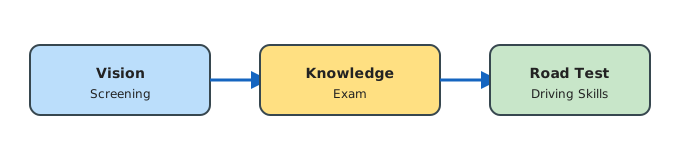
Typical order (verify official flow):
- Document + identity verification
- Vision screening
- Knowledge (written) exam
- Instruction permit phase (practice driving under supervision)
- Road test (skill/driving test)
Progression requires passing earlier steps and meeting any time, age, or supervised hour requirements.
2. Vision screening
Visual overview
Purpose: Ensure minimum visual acuity and peripheral vision to drive safely.
You should:
- Address correctable vision issues (e.g., updated prescription lenses) before testing.
- Know whether you must wear corrective lenses; license may include a restriction code if required.
Failure pathway: If you do not meet standards, you may need an eye professional’s statement or to improve with corrective measures before proceeding.
3. Knowledge exam
Scope (paraphrased categories):
- Signs, signals, and pavement markings.
- Right‑of‑way rules, lane usage, and speed management.
- Parking regulations and special condition driving (weather, nighttime, work zones).
- Effects of impairment (alcohol, drugs), distractions, and safety practices.
- Point system basics (consequences of violations).
Effective study pattern:
- Active reading: Summarize each section into bullet points.
- Spaced recall: Quiz yourself daily using self‑generated questions.
- Mixed practice: Interleave topics (signs, right‑of‑way, parking) to build flexible recall.
- Error log: Track missed practice questions; revisit underlying guide paragraphs.
Common mistakes:
- Pure passive reading without recall.
- Cramming only night before exam.
- Ignoring signage nuances (shape/color coding).
4. Road test readiness
Indicators you might be ready (verify official supervised hour requirements):
- You can execute smooth starts, stops, lane changes, and turns without prompts.
- You consistently check mirrors and blind spots (head movement) before lane changes & merges.
- You maintain safe following distance and speed adaptation.
- You scan ahead for hazards (pedestrians, signals, brake lights).
- You self‑correct minor errors immediately.
Pre‑test checklist:
- Vehicle: Lights, signals, horn, mirrors, tires all functional; valid registration & insurance.
- Documents: Permit/license, required ID, any completion forms.
- Practice: Several recent drives in varied conditions (day/night, urban/suburban) if allowed.
5. Road test structure
Typical evaluated elements:
- Vehicle control: Steering, acceleration, braking smoothness.
- Observation: Mirror checks, shoulder checks, hazard scanning.
- Positioning: Lane centering, proper entry/exit from turns, correct lane choices.
- Compliance: Speed limits, signals, right‑of‑way rules, stop line adherence.
- Communication: Timely signaling, appropriate horn use (rarely needed).
Immediate disqualifiers (examples—verify specifics):
- Running a red light or failing to stop at a stop sign.
- Dangerous maneuvers (near collision, severe speeding, reckless lane change).
- Ignoring examiner instructions repeatedly.
6. Managing test anxiety
Approaches:
- Structured breathing: Slow exhale before key maneuvers.
- Verbalizing steps during practice ("Mirror, signal, shoulder check, move").
- Mock exams with a supervising adult acting as examiner.
- Sleep and nutrition: Avoid fatigue and low blood sugar.
Reframing: Treat the test as a demonstration of consistent habits—not perfection.
7. Failure analysis & retest strategy
If unsuccessful:
- Write a brief post‑test reflection: list concrete errors.
- Categorize: Observation, control, rules, positioning, anxiety.
- Target: Design short drills for each category (e.g., mirror + shoulder check repetition in empty lot).
- Schedule retest only after demonstrable improvement, not arbitrary waiting.
Knowledge retest: Focus on missed question types; craft 1–2 new questions from the guide paragraphs you misunderstood.
8. Ethical & safety focus
Passing demonstrates minimum competence. Ongoing responsibility:
- Continue practicing advanced defensive driving (space & time margins).
- Resist complacency: Revisit guide highlights periodically.
- Model safe behavior for peers (especially during early unsupervised driving).
Quick self‑check
- Can you list the exam sequence from vision to road test?
- What are three indicators you’re road‑test ready?
- Name two categories of knowledge exam content that you must study actively.
Proceed to the Chapter 2 Interactive Quiz when confident.
3 things to remember
- Exam order: documents/vision → knowledge → supervised practice → road test.
- Road test readiness: smooth control, consistent checks, safe gaps, and hazard scanning.
- After misses, analyze errors by category and drill before retesting.