License Basics (Chapter 1)
TL;DR
Missouri Class F in one line: know the GDL stages, bring ID/SSN/residency proofs, and follow the vision > knowledge > road test path—always confirm exact ages and limits in the official guide.
What this chapter covers
Overview of Missouri Class F (non-commercial) driver licensing: who is eligible, how Graduated Driver Licensing (GDL) works, which documents you need, and your responsibilities to keep your license valid.
Learning objectives
- Differentiate permit, intermediate, and full license stages (GDL) and their purposes.
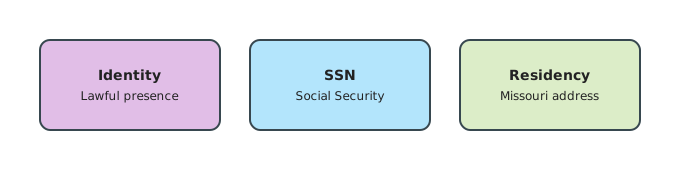
- Identify required proofs (identity/legal presence, Social Security number, Missouri residency).
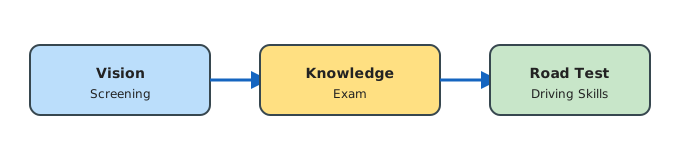
- Describe the vision, knowledge, and road testing sequence at a high level.
- Explain renewal basics and when you must report name or address changes.
Verify official specifics
Numeric details (ages, timeframes, passenger limits, time-of-night restrictions, renewal periods, and distances) can change. Always verify the latest Missouri Driver Guide for exact values.
1. Class F overview
Class F is Missouri’s standard non-commercial license for operating typical passenger cars and light trucks. It does not authorize commercial driving (CDL) or motorcycle operation unless properly endorsed.
Key ideas:
- It’s a privilege granted by the state, conditioned on knowledge, skill, and safe conduct.
- Operation requires current, valid licensing; driving on an expired, suspended, or revoked license can lead to points and further sanctions.
2. Graduated Driver Licensing (GDL)
GDL phases let new drivers gain experience in lower-risk steps before full privileges. Missouri's structure (verify specifics in the official guide) generally includes:
- Instruction permit
- Supervised driving only with a qualified, properly licensed adult in the front seat.
- May include passenger and nighttime limits intended to reduce exposure to high‑risk conditions.
- Intermediate license
- Allows unsupervised driving with specific limitations (for example, nighttime driving windows and passenger count rules for younger drivers—verify details).
- Clean driving history for a minimum period is typically required to progress.
- Full license
- Graduated restrictions lift once age, time, and incident‑free criteria are met.
Why this matters:
- Crash risk is highest early in licensure; restrictions target the riskiest conditions (night driving, multiple teen passengers) to improve outcomes.
3. Documents and identification
Expect to provide original or certified documentation in the following categories:
- Identity and lawful presence (e.g., birth certificate or passport; verify accepted forms).
- Social Security number (card or acceptable proof).
- Missouri residency (usually two documents such as utility bill, bank statement, or lease).
Tips to avoid delays:
- Names must match across documents; fix mismatches with the issuing agency first.
- Bring recent, legible documents. Electronic proofs may be allowed in some cases—verify.
REAL ID note
Missouri issues both REAL ID‑compliant and non‑REAL ID credentials. Review the state’s REAL ID guidance to decide which you need for federal facility/air travel purposes.
4. Testing sequence (high level)
You'll typically complete:
- Vision screening
- Confirms minimum acuity and peripheral awareness for safe driving.
- Knowledge exam
- Multiple‑choice rules-of-the-road, signage, and safe driving practices.
- Road test
- Demonstrates basic control, observation, signaling, and compliance with law.
Note: Chapter 2 ("Exam Process") covers test logistics and readiness in greater detail.
Visual overview
5. Validity, renewal, and changes
- Renewal periods can vary by age category. Check your credential’s expiration date and renew ahead of time.
- You must update the state after a legal name change or change of address within the required timeframe.
- Keep your license accessible while driving; some interactions, like traffic stops or crashes, require you to present it.
Consequences of lapses:
- Driving after expiration or during a suspension/revocation can lead to citations, points, and insurance/record impacts.
6. Responsibilities and safe conduct
Licensing signals minimum competence, not perfection. Ongoing responsibilities include:
- Drive sober and alert; never drive impaired by alcohol, drugs, or fatigue.
- Maintain financial responsibility (insurance) and legal registration of your vehicle.
- Model courteous, predictable behavior—signal early, yield appropriately, and manage space.
7. Common pitfalls and how to avoid them
- Incomplete documentation → Use a printed checklist and verify acceptable forms on the state site.
- Name/address mismatches → Resolve with SSA and issuing agencies before your visit.
- Overlooking GDL limits → Post a reminder card in the vehicle; set phone alerts for time windows.
- Studying passively → Use active recall (cover the page, list key points, check, repeat).
Quick self‑check
- Which GDL stage still requires supervision? What are typical goals of its restrictions?
- Which document categories must you bring? What happens if your name differs across them?
- What are the three testing components and their purposes?
Proceed to the Chapter 1 Quiz when you can answer these confidently.
3 things to remember
- GDL stages build experience safely before full privileges; know each stage’s limits.
- Bring identity, SSN, and Missouri residency proofs that match across documents.
- The sequence is vision → knowledge → road; prepare actively, not passively.
Quick Flashcards
Quick Review
What is the main goal of GDL?
Let new drivers gain experience in lower risk steps before full privileges.What are the three test components in order?
Vision screening, knowledge exam, and road test.Which three proof categories are commonly required?
Identity and lawful presence, Social Security number, and Missouri residency.Documents at a glance